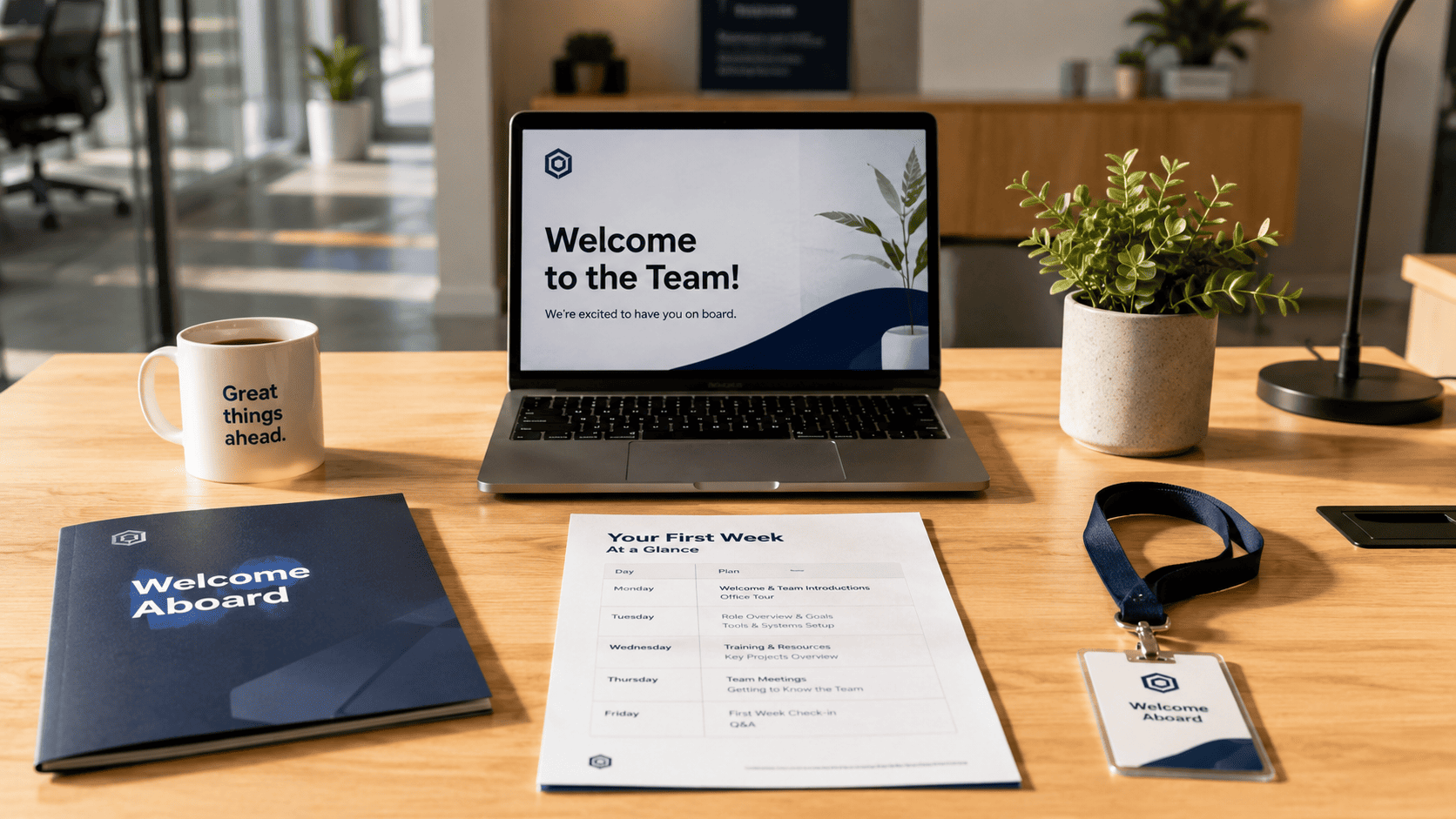
Research consistently shows that the quality of onboarding has a direct effect on retention. Employees who have a structured, positive first experience are more likely to stay beyond their first year and reach full productivity faster. Despite this, many organisations still treat onboarding as little more than a pile of forms and a tour of the office.
Building a proper onboarding programme does not require significant resources. It requires clarity about what a new starter needs to know, a consistent way to deliver it, and a way to track that it has happened. Here is how to approach it.
Start with what every new starter needs
Before thinking about tools or timelines, map out the content. Every onboarding programme should cover three areas:
- Compliance and safety: the training required by law or company policy before someone starts work. This includes health and safety induction, fire safety, data protection, and any role-specific compliance training.
- Company knowledge: how the organisation works, its values, structure, policies, and key processes. This is often underdocumented but has a significant impact on how quickly someone settles in.
- Role-specific training: the skills, systems, and knowledge specific to what the person will actually be doing. This varies by role and should be built in close collaboration with the hiring manager.
Structure it by timeline
Onboarding should not all happen on day one. Overloading a new starter with information before they have any context leads to low retention of what they have been told. A better structure is to spread content across the first few weeks:
Before the start date
If possible, send compliance training ahead of the first day. This removes the pressure of completing mandatory modules on an already overwhelming day and means the person arrives already ticked off the basic legal requirements. A simple welcome email with access to the platform and a short list of pre-start courses works well.
Day one
Focus on the essentials: site induction, emergency procedures, access to systems, and introductions. Keep day one eLearning to a minimum. The priority is making the person feel welcome and oriented, not processing information.
Week one
Complete any remaining compliance training. Introduce company processes, tools, and key contacts. Assign role-specific modules that give context for what they will be working on. Keep sessions short; 15 to 30 minutes is plenty for eLearning content in the first week.
First month
Deepen role-specific training. Introduce more complex processes as the person has more context to make sense of them. Check in at the two-week and one-month marks, with a short conversation or survey, to identify gaps and adjust the programme.
Use eLearning for the content that scales
Some onboarding content is best delivered in person: introductions, culture conversations, hands-on systems training. Other content is well-suited to eLearning: compliance modules, company policy overviews, process documentation, and knowledge checks.
eLearning for onboarding works well when it is consistent (every starter gets the same information), trackable (you can see who has completed what), and available on demand (people can revisit modules when they need to). In-person time is better spent on things that benefit from human interaction.
Track completion from the start
An onboarding programme is only as reliable as your ability to see whether it is being completed. For compliance training in particular, being able to confirm that a new starter has completed required modules before beginning certain tasks is not just good practice; it can be a legal obligation.
Your training system should make it straightforward for HR and the line manager to see, in real time, which modules a new starter has completed and which remain outstanding. Follow-up should be prompted by the system, not by someone remembering to check.
Iterate based on feedback
The first version of an onboarding programme is never the finished version. After each cohort of new starters has completed the programme, gather feedback: what was useful, what was unclear, what felt irrelevant, and what was missing. The programme improves over time with relatively little effort if feedback is collected consistently.
Start simple
A common mistake is waiting until the perfect programme exists before rolling anything out. A simple, consistent set of modules covering the compliance essentials plus a basic company introduction is better than nothing, and far better than the informal, inconsistent onboarding that most organisations currently deliver.
Once the fundamentals are in place, they are easy to build on. Start there.
The Learning Road makes it straightforward to build an onboarding programme, assign it to new starters, and track completion in one place. If you would like to see how it works in practice, browse the courses.